MAJOLICA: Colors (d) Outlines
ca: MAJÒLICA: Colors (d) Contorns
es: MAYÓLICA: Colores (d) Contornos
 Introduction to using colors: Painting the outlines is drawing with your paintbrush. Use a cut down brush to paint the outlines and any small details. All strong colors can be used for outlines, the following five colors are the main ones. Remember, when I talk about colors, the preparation of them has been previously explained and stirring them helps to make them run well, this is very important for painting long, smooth strokes.
FIVE MAIN COLORS FOR OUTLINES
Manganese: is a dark brown that has been used throughout the centuries for painting outlines. When fired, it burns away so when using it for outlines, it must be well mixed and strong.
Brown: Instead of using manganese we now use 50% brown-red + 50% strong brown
Black: is a new, hard, industrial color and should be used for designs that need to have an impact, like names, advertisements, instructions, etc.
Blue: one of the oldest colors and one that has been used through the centuries for designs of a single color, but in different shades. For the outlines and extreme dark shading you need a strong color, so a little black is added.
Brown-red: a good color for outlines. To make it darker, it can be mixed with dark brown or black. Though not an antique color, it is good for fine lines.
THE PICTURES SHOW THE OUTLINES PAINTED.
The following are three ways that you can paint outlines.
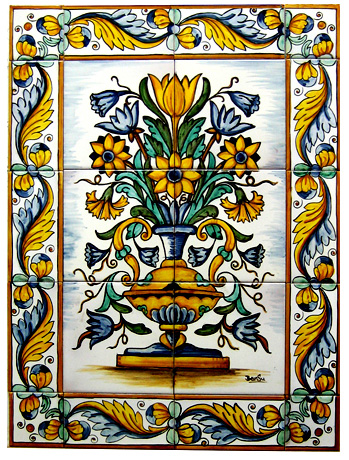
1) Outlines before colors. First paint the outlines, which have been marked on with charcoal powder, with long smooth strokes, using the movement of brush strokes to accentuate the drawing and adding small details to personalize and accentuate it and then add the colors. Illustration a).
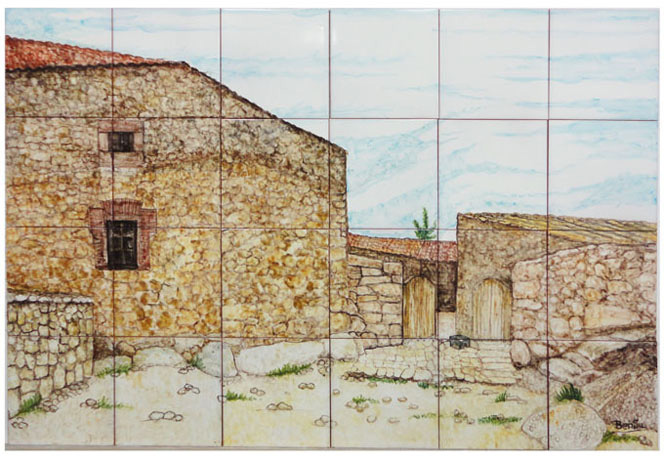
2) Painting colors before outlines, This is usually done when creating a colored texture. Imagine, for example, that you are painting a castle which has large spaces of brick wall. Mark on a design and paint only the outlines, no details like windows or doors, then dust off all the charcoal powder and paint in the light colors, light brown, light red-brown and green, overlapping them to form shades and colors, to give an idea of the changing colors that bricks have. Then mark on the missing parts of the design over the colors and paint in all the details; bricks, windows, doors, etc. When the outlines are finished, add more colors if necessary. Illustration b).
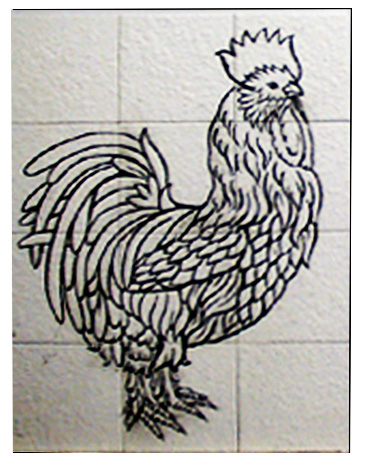
3) Strong outlines. This creates a similar effect as dry-cord, the outlines need to be very strong and black is usually used. The outlines are painted then the colors and shadings are added, the lines are repainted and made thicker and stronger. In some parts this is not done as can be seen in the green and yellow round the beak. The illustration c) shows the outlines painted and illustration d) the colors added and the outlines repainted.
Note: When I use the word light in relation to a color, I mean exactly the same color but with more water or a lighter stroke
Click on the image to enlarge it